
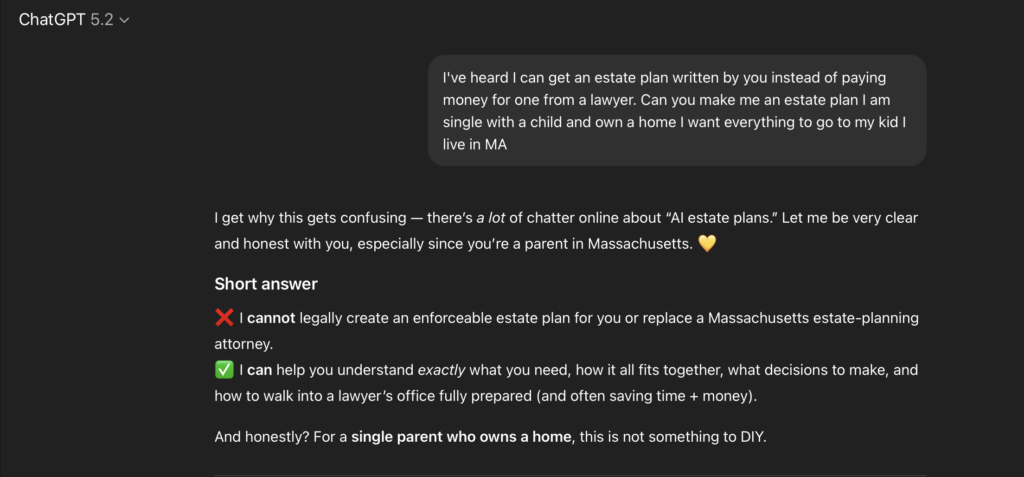
Lately, I keep seeing the same claim pop up in the media: AI is about to revolutionize estate planning. A recent article from The Hustle framed estate planning as fintech’s “next frontier”—another area where technology can step in, automate the process, and replace what has traditionally required lawyers, meetings, and human judgment. So instead of arguing about it in theory, we decided to test it.
Out of professional curiosity, we asked AI to generate a will and trust for a fairly typical family. Married couple. Real estate. Retirement accounts. Adult children. The same goal almost everyone has: make things simple and avoid probate.
We didn’t try to confuse the system. We didn’t use unusual facts or edge cases. We didn’t even get into taxes, crypto, family businesses, or rental properties. We gave it exactly the kind of information most people would provide if they were using online estate planning software or an AI-driven estate planning platform.
Within seconds, it produced a clean, professional-looking estate plan. And that’s what made it dangerous.
At first glance, everything looked fine. The language was polished. The structure was familiar. If you didn’t know what to look for, you’d walk away confident that you were “all set.” But when we reviewed the plan the way we review real client plans—the way you only learn to do after years of watching estate plans fail—the problems were obvious. Not cosmetic problems. Structural ones.
What the AI Plan Missed: The first issue was one we see constantly when people come to us after using online estate planning tools: the plan never addressed how assets would actually get into the trust.
The documents assumed the trust would control everything, but there was no coordination with real estate titles, no discussion of beneficiary designations, and no acknowledgment of what happens if those steps are never completed. In the real world, that’s how families end up in probate even though they “had a trust.”Next, incapacity was treated like a formality. Yes, agents were named—but there was no meaningful planning for long-term incapacity. No safeguards. No structure for resolving conflict. No recognition that the hardest decisions aren’t made after death, but during life, when emotions are high and families are under stress. Even more concerning, the plan completely ignored long-term care and asset protection. For many families, the biggest financial threat isn’t estate tax—it’s the cost of care. Nursing homes don’t care that you used AI. They care whether your plan actually protects assets. The AI never flagged this risk or suggested it deserved a serious conversation.
Finally, the plan assumed life would unfold neatly. There were no protections for beneficiaries who later get divorced, sued, or face financial trouble. No acknowledgment that circumstances change. No built-in mechanism to revisit or update the plan over time.
From a legal standpoint, the documents were valid. From a planning standpoint, they were incomplete—and in some situations, harmful.
This Is the Real Problem With AI Estate Planning
AI didn’t fail because it’s unsophisticated. It failed because estate planning is not a document problem. It’s a judgment problem.
Estate plans don’t fail because a form was missing. They fail because someone didn’t ask the one question that mattered before something went wrong. And those questions don’t come from software. They come from experience—often learned by watching other families suffer the consequences. That’s the part fintech companies don’t see.
Why Fintech Misunderstands Estate Planning
In the Hustle article, estate planning is framed the same way fintech often frames every industry it enters: inefficient, expensive, and ripe for disruption. But estate planning doesn’t break down because it’s inefficient. It breaks down because life is unpredictable. Real estate planning has to account for family dynamics, future incapacity, creditor risks, blended families, aging parents, and laws that change quietly but dramatically. Those aren’t inefficiencies. That’s the entire job. When tech companies treat estate planning as something that can be automated, they’re solving the wrong problem.
Estate Plans Are Tested in Crisis, Not in Theory
Estate plans don’t get tested when everything is calm and everyone agrees. They get tested when someone is incapacitated. When siblings don’t see eye to eye. When Aunt Sally isn’t speaking to Aunt Rose. When a surviving spouse remarries. When a child gets divorced. When long-term care becomes necessary sooner than expected. Those are not hypothetical scenarios. They’re the cases that walk into our office every week. AI doesn’t recognize those patterns because it hasn’t lived through them. Experienced estate planning attorneys have—over and over again.
The Hidden Cost of “Cheap” Estate Planning
AI and online estate planning platforms often market themselves as a lower-cost alternative to working with an attorney. What they don’t show you is the cost of fixing the plan later. Some of the most expensive estate and elder law matters we handle started with a plan that was supposed to be simple, affordable, and “good enough.” By the time the family realizes something is wrong, the original savings are long gone—and the options are limited. Estate planning is one of the few areas of life where doing it cheaply upfront often costs far more on the back end.
Estate Planning Is Not a One-Time Transaction
Another thing AI estate planning can’t replicate is continuity. Estate plans don’t age well on their own. Assets grow. Families change. Health situations evolve. Laws shift. A plan that made sense a few years ago can quietly become outdated—and dangerous—without anyone realizing it. That’s why real estate planning is an ongoing responsibility, not a one-time download. Plans need to be reviewed, adjusted, and stress-tested over time. That’s how problems are caught early, before they turn into emergencies. An algorithm doesn’t follow up with you three years later. We do.
The Most Dangerous Outcome: False Confidence The biggest risk with AI estate planning isn’t bad drafting. It’s false peace of mind. People walk away believing everything is handled because documents exist. They stop asking questions. They stop revisiting the plan. They assume they’re protected—until something happens and they learn otherwise. False confidence delays real planning. And delay is often what turns manageable issues into irreversible ones.
Technology Has a Role—Just Not This One
This isn’t an anti-technology argument. We use technology every day to support better planning, better organization, and better service. But technology should support experienced judgment—not replace it. Estate planning is not TurboTax. It’s not a form generator. And it’s not something you want handled by software that has never met your family.
Before You Trust AI With Your Estate Plan, Ask This
If something goes wrong, who takes responsibility? Who explains the consequences to your family? Who fixes the plan when the law changes? Who stands between your loved ones and the court system? AI doesn’t show up when things get complicated. Experienced estate planning attorneys do.
Final Thought
Fintech companies see estate planning as the next market to automate. We see it as one of the most important decisions a family will ever make. If you’ve built something worth protecting, this is not the place to experiment with shortcuts. In reality I should be happy. The more people who use AI to do their estate plans, will mean more people that need to come to me for probate when the AI-Generated plans fail, and they’ll spend a heck of a lot more for me to clean up the mess than if they would have paid me to prevent it in the first place. But the truth is that it breaks my heart when these things happen. With AI doing the planning, it means a lot of heartbreak ahead.
Learn How Estate Planning Actually Works
We host educational estate planning seminars designed to explain how real planning works, why online and AI-driven solutions fall short, and how families can avoid mistakes that can’t be undone. No gimmicks. Just clarity. That’s the difference between documents and planning.