
Probate in Massachusetts is the legal process for settling someone’s estate after they die, including establishing who has authority to handle their affairs and how property in their probate estate will reach the people entitled to receive it.
That sounds straightforward until you’re the one standing at the bank with a death certificate and your parent’s will, wondering why you still can’t close an account. The bank needs proof that you have the legal authority to act, and being named in the will is generally only the starting point.
A Will Does Not Mean Your Family Avoids Probate
One of the biggest misunderstandings about estate planning is that having a will means your family won’t need probate. A will gives instructions about where your probate assets should go and identifies the person you want handling the estate, but it doesn’t move those assets out of your name while you’re alive. If you die owning an account in your name alone, with no surviving joint owner or effective beneficiary designation, someone will generally need authority through the estate process to collect and distribute it. See the Massachusetts guidance on when probate is necessary.
Who Actually Does the Work: The Personal Representative
The person appointed to handle that work is called the personal representative, although plenty of people still use the word executor. Their job includes identifying estate property, dealing with valid debts and expenses, addressing taxes, and distributing what remains. If there’s a valid will, its instructions generally govern the distribution, subject to Massachusetts law. If there isn’t a will, Massachusetts intestacy law determines who inherits. Your family doesn’t get to substitute whatever arrangement seems fairest simply because everyone has a different understanding of what you would have wanted.
Whether Probate Is Required Depends on How Each Asset Is Owned
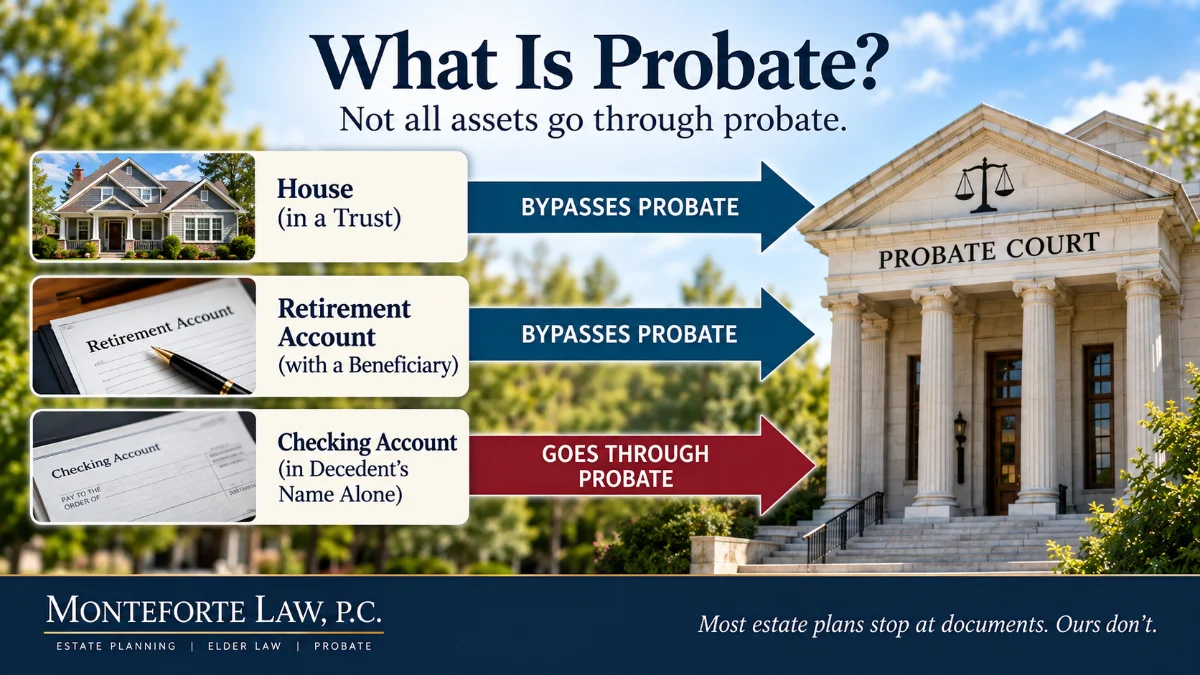
Whether probate is needed depends heavily on how each asset is owned. A home owned with a spouse with rights of survivorship generally passes to the surviving spouse outside probate. An account with a valid beneficiary designation can usually pass directly to that beneficiary, and property properly held in a trust is handled under the trust’s terms. Those arrangements still involve paperwork after a death, but the transfer typically doesn’t require that particular asset to go through probate. The deed, account agreement, or beneficiary designation matters more than what the family assumes was set up.
An Example: The One Account Nobody Coordinated
Imagine a mother who leaves a house, a retirement account, and a checking account. Her house is properly titled in her trust, and her retirement account names her two children as beneficiaries, but the checking account remains in her individual name without a beneficiary. The house and retirement account may pass outside probate while the checking account needs an estate procedure. The family can have a well-organized estate plan and still need help with one asset that was overlooked, opened later, or never coordinated with the rest of the plan.
Voluntary Administration: The Simplified Route for Small Estates
Massachusetts also offers a simplified process called voluntary administration for certain small estates. Generally, it applies when the probate estate consists entirely of personal property worth $25,000 or less, excluding one car, and the other eligibility requirements are met. That can make a meaningful difference when the remaining asset is a modest bank account. A house that needs to pass through the estate, however, can change which procedure is available, even if there is very little cash. See the Massachusetts overview of estate procedures.
Avoiding Probate Is Not the Same as Having Nothing Left to Do
It also helps to understand that avoiding probate doesn’t automatically eliminate taxes or other responsibilities after death. The property counted for estate tax purposes can include assets that pass outside probate, so “there’s nothing to probate” and “there’s nothing left to do” are different conclusions. A family may still need help administering a trust, handling tax filings, or documenting a real estate transfer. See the Massachusetts Estate Tax Guide.
Where to Start
The most useful first step is to gather the will, any trust documents, recent account statements, beneficiary information, and the deed to any real estate. Once we can see what the person owned and how they owned it, we can explain which assets need probate, which can pass another way, and what your family actually needs to do next.
Not sure whether your family needs probate at all?
Book a free 15-minute consult call with our Lead Intake Coordinator, Nicole Ott, or give us a call at 978-657-7437. There is no charge and no pressure — the goal is simply to work out what your family actually needs to do next.
You can also download our free checklist, What To Do When A Loved One Passes Away.